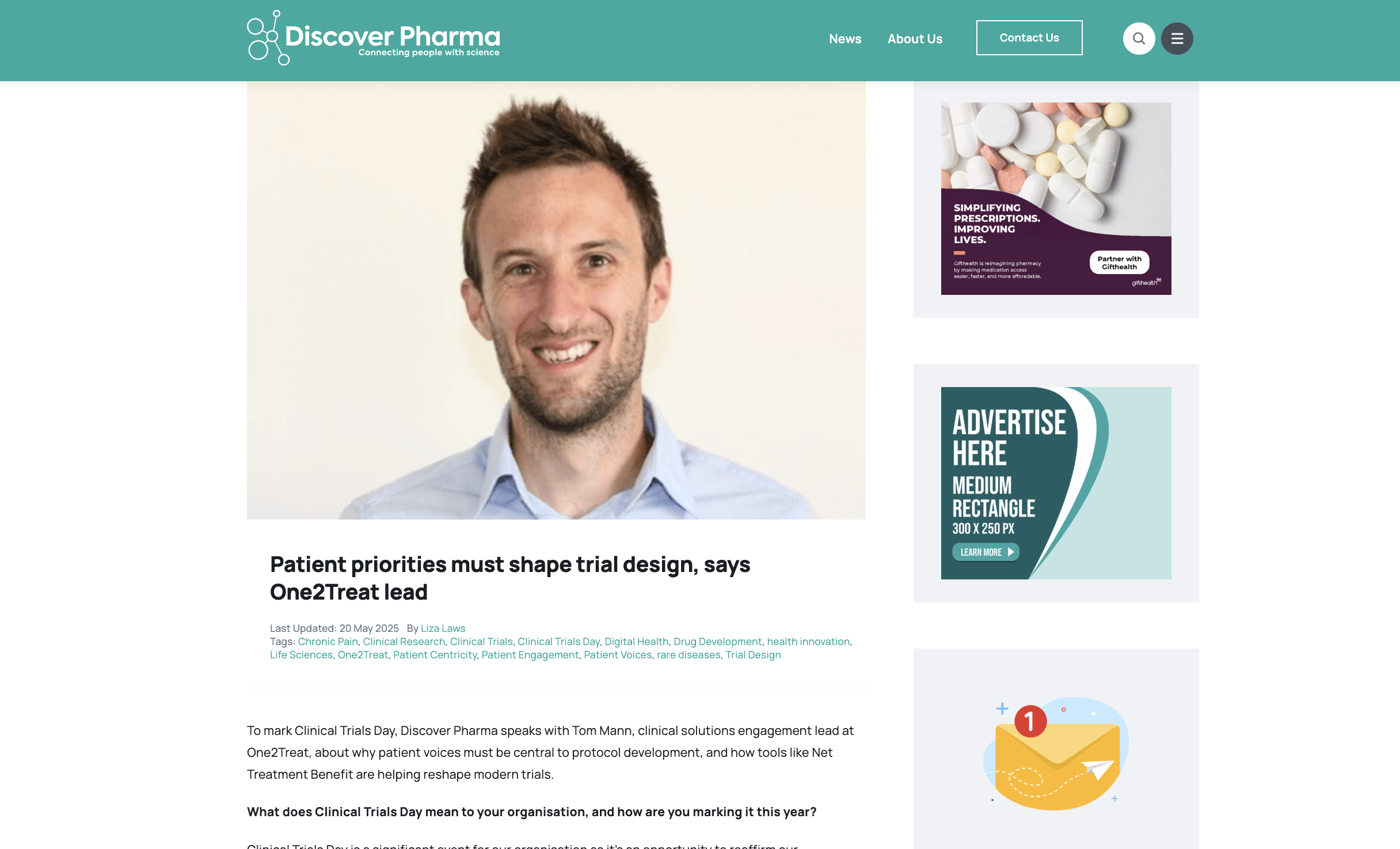
Patient priorities must shape trial design
BackOriginal content written by Tom Mann and published on Discover Pharma.
To mark Clinical Trials Day, Discover Pharma speaks with Tom Mann, clinical solutions engagement lead at One2Treat, about why patient voices must be central to protocol development, and how tools like Net Treatment Benefit are helping reshape modern trials.
What does Clinical Trials Day mean to your organisation, and how are you marking it this year?
Clinical Trials Day is a significant event for our organisation as it’s an opportunity to reaffirm our commitment to patient-centricity in medical research. This year, we’re placing a spotlight on incorporating patient perspectives from the earliest stages of trial planning. By engaging with patients and clinicians before protocol design, sponsors can create trials that align more closely with real-world experiences and outcomes. One2Treat’s approach focuses on including multiple patient-relevant outcomes in assessments to better reflect overall treatment effects.
How do you gather and incorporate patient insights into protocol design?
Recent regulatory guidance stresses the need to bring patient preferences into trial design from the outset. One of the best tools to do this is the Net Treatment Benefit (NTB), derived from the Generalized Pairwise Comparisons (GPC) statistical method. NTB captures the probability that a random patient on treatment will do better than one on control, based on a hierarchy of prioritized outcomes.
NTB is especially powerful because it allows tailoring of these outcome hierarchies based on different stakeholder views—patients, clinicians, caregivers. This gives advocacy groups and individuals a real voice in shaping endpoints.
We’ve also developed One2Treat Voice, a software tool that helps formalise this process. It guides users through comparative questions about patient profiles to identify which outcomes matter most and how they should be ranked.
What unmet need or therapeutic area do you think is ripe for a clinical trial breakthrough?
The biggest unmet need isn’t tied to a specific disease, but rather how trials are designed—particularly in areas where traditional primary endpoints don’t reflect patient experience. Think chronic pain, neurological conditions, and rare diseases. These require assessments that go beyond efficacy and include safety and quality of life.
Breakthroughs will come from tools that can holistically evaluate these dimensions, increase statistical power, and reduce sample sizes—making trials more efficient and meaningful.
What’s your biggest prediction for how clinical trials will change by 2030?
By 2030, the most impactful innovation will be the integration of patient voices into trial design. Tools that facilitate early engagement will become industry standards, improving relevance, accelerating timelines, and increasing trial success.
This patient-first mindset will define the next generation of clinical research and lead to treatments that are not only effective, but truly valued by those who use them.
If you could change one thing about the current trial ecosystem, what would it be?
We’d empower pharma companies with practical tools to engage patients and advocates much earlier in the process. When protocols are co-designed with both patients and clinicians, trials become more relevant and accessible—resulting in better recruitment, retention, and real-world impact.
Read also