Patient-centric clinical trial design

Design clinical trials around what matters most
Patient-centric clinical trial design starts by understanding which treatment outcomes matter most to patients and other stakeholders.
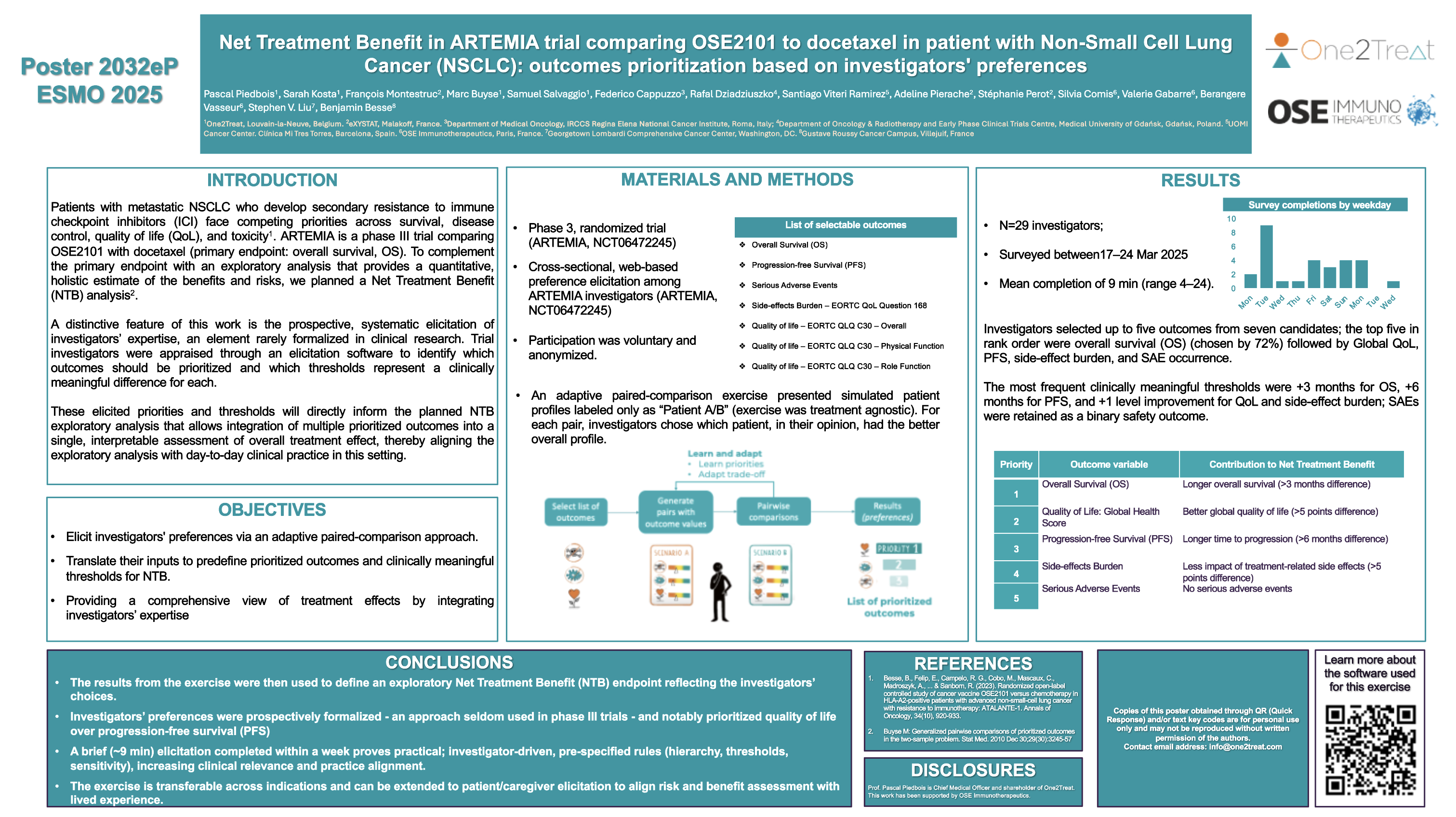
One2Treat Voice® enables sponsors to capture, quantify and prioritize these preferences, providing an evidence-based foundation for clinical trial endpoint design.
The resulting hierarchy of outcomes can inform a multidimensional treatment assessment using Net Treatment Benefit (NTB), bringing multiple clinically relevant outcomes together according to their relative importance.
Bring the patient voice into trial design
Clinical trials can assess many aspects of treatment, including survival, disease progression, symptoms, adverse events, treatment burden and quality of life. These outcomes are not necessarily equally important to patients.
One2Treat Voice provides a structured way to understand which outcomes matter most and how they should be prioritized.
How it works
- Identify Outcomes
Define the clinically relevant outcomes that could contribute to the assessment of treatment benefit. - Capture preferences
Use One2Treat Voice to collect preferences from patients, clinicians and other relevant stakeholders. - Quantify Priorities
Translate stakeholder preferences into a quantitative hierarchy of outcomes. - Inform trial design
Use these priorities to support endpoint selection and a multidimensional treatment assessment using NTB.
Quantify what matters most
One2Treat Voice is software for systematically capturing and quantifying patient and stakeholder preferences during clinical trial design.
It provides a transparent way to understand how different stakeholder groups prioritize clinically relevant outcomes and where their priorities align or differ.
Combine multiple outcomes in a single treatment assessment
Treatments rarely affect patients through a single outcome. A treatment may improve survival while also affecting symptoms, adverse events or quality of life.
Net Treatment Benefit provides a framework for evaluating multiple outcomes together according to a pre-specified hierarchy.
Using Generalized Pairwise Comparisons, treatment groups are compared across prioritized outcomes to produce an integrated assessment of treatment benefit.
When the hierarchy is informed by stakeholder preferences, the assessment can reflect both clinical priorities and what matters most to the people affected by the treatment.
Putting patient preferences into practice
OSE Immunotherapeutics and One2Treat jointly won the Innovation award for Endpoint Design in the 2025 Clinical Trials Arena Excellence Awards

Frequently Asked Questions
Systematically capture patients’ preferences about which treatment outcomes matter most, quantify those preferences and use the resulting priorities to inform endpoint design. One2Treat Voice provides software to support this process.
Identify outcomes that are meaningful to patients, capture their preferences and use these priorities to inform outcome selection and endpoint design.
Patient preferences can provide evidence for selecting and prioritizing outcomes within an endpoint strategy. Quantifying these preferences creates a transparent basis for incorporating the patient perspective into trial design.
Multiple outcomes can be evaluated together using a pre-specified hierarchy and a multidimensional analysis such as Net Treatment Benefit. This allows outcomes such as survival, safety, symptoms and quality of life to contribute to an integrated treatment assessment.
One2Treat Voice is software that captures, quantifies and prioritizes patient, clinician and other stakeholder preferences. The resulting outcome hierarchy can inform patient-centric clinical trial design and multidimensional treatment assessment.
Preferences should be collected early enough in clinical development to influence decisions about outcome selection and endpoint design, before these decisions are finalized.
Business Cases